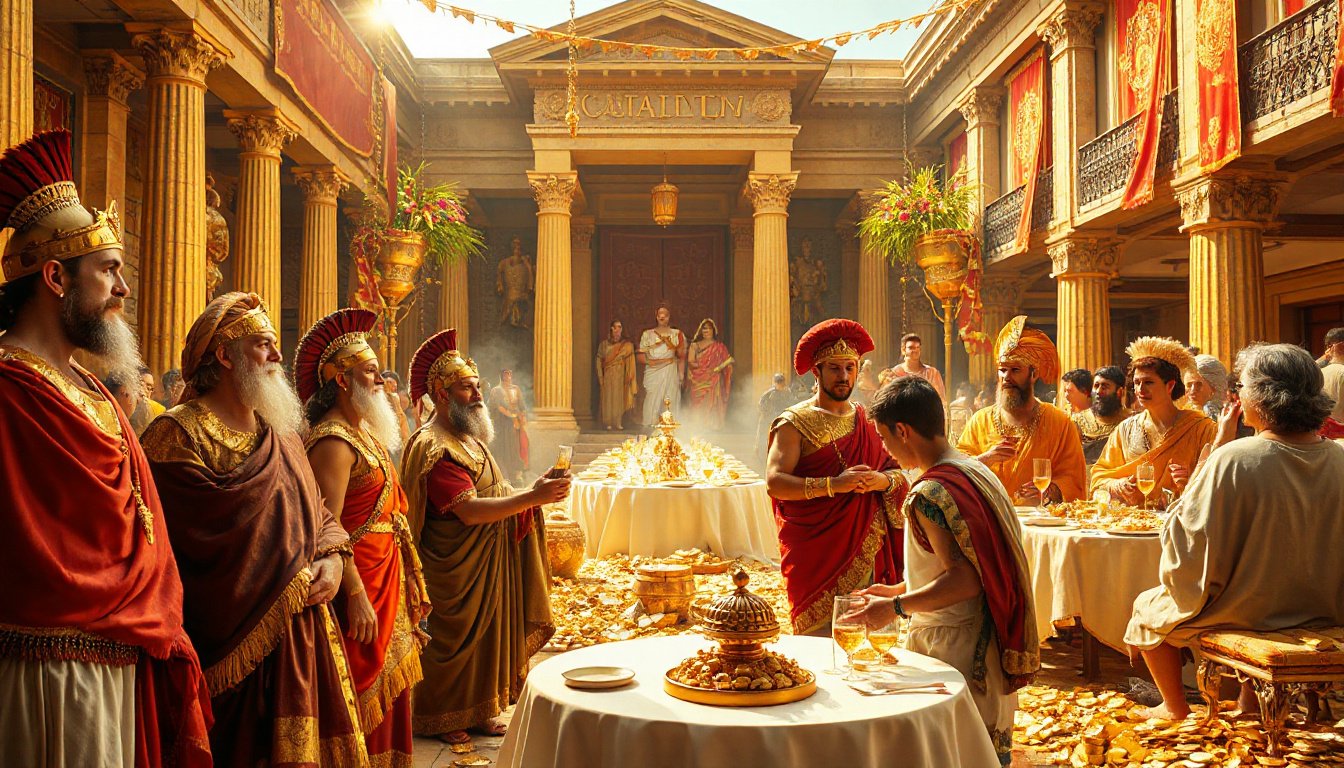
Jewelled Eels, Golden Beards, and Unfathomable Cruelty: Exploring the Eccentric Lives of Five Ancient Roman Leaders
Ancient Rome reached high in law, engineering, and government. Its rulers also showed traits that were both colorful and odd. Many leaders used their power in ways that mixed humor with fear. This article looks at five leaders who acted in strange and shocking ways. Their private habits mixed with their public roles, and their actions often changed the course of events.
Hortensius: A Lover of Wine-Watered Trees
Hortensius (114–50 BCE) stood out in the late Republic as an orator and a politician. He cared deeply for the plane trees on his estate. Hortensius watered these trees with wine, not with plain water. When one tree grew weak, he stopped a legal hearing so he could see it. His behavior made some, like Cicero, mock him and his group of fishpond fans for ignoring their social duties.
Marcus Licinius Crassus: The General and His Jewelled Eel
Crassus worked as a general and a politician. He held strong ambitions and won many battles. He kept pet eels in a well-kept fishpond. One eel received special care and wore fine jewels. When that eel died, Crassus held a three-day funeral. His act made others laugh at the waste of wealth and nobility. In 53 BCE, he led a campaign against the Parthians in Mesopotamia and lost his life along with 20,000 soldiers after a fatal march in dry land.
Caligula: The Emperor, His Horse, and Golden Beards
Caligula (ruled 37–41 CE) ruled with near-absolute power. He showed cruel behavior and a strong change of moods. He once planned to make his horse, Incitatus, a consul. The horse lived in fine stables and had many attendants. Caligula sometimes dressed as a god. He wore a golden beard and carried a symbol like a thunderbolt. His court held long trials that led to many executions. At times, stories said he broke social rules by harming family. His reign stopped when he was killed in 41 CE by those who feared his rule.
Nero: The Artist Emperor and Architect of Excess
Nero (54–68 CE) became famous for his cruel acts and his love of art. He is known in lore for playing music while Rome burned in 64 CE, though this is not proven. After a large fire, Nero built a grand palace with 300 rooms. He started a festival where he sang and competed in shows. Many in the elite mocked his passion for performance. Nero also planned the death of his own mother, Agrippina, first using a collapsing ship and later ordering her assassination. His rule ended in 68 CE after the people turned against him and he committed suicide.
Commodus: The Gladiatorial Emperor
Emperor Commodus (ruled 180–192 CE) acted in ways that shocked Rome. He stepped into the arena and fought as a gladiator over 700 times by some reports. Commodus idealized Hercules by dressing like the hero. He took part in fights with a style that Roman art later remembered. His rule was harsh, and he once had his sister, Lucilla, put to death after a coup was suspected. When his friends left him, he was killed by a strangling in his bath.
Elagabalus: The Young Syrian Emperor and Religious Revolutionary
Emperor Elagabalus took power at the age of 14 in 218 CE. His actions shocked many Romans. He wedded a Vestal Virgin, a move that broke old rules. He built a temple in Rome for a Syrian sun god. In that temple, a black meteorite stood as the god’s symbol. Elagabalus married several people, including a male partner named Hierocles. Some accounts tell that he took on roles seen as feminine. Even if ancient writers may have exaggerated these acts, they show a leader who defied old customs.
Power and Peril: Eccentricity Coupled with Absolute Authority
These stories show how odd behavior in powerful men could both entertain and terrify. In Rome, leaders made rules where life and death hung on a decision. The personal habits and strange acts of these men could change the course of events. Their lives remind us that the mixing of personal whims and state power can shape a nation.
This article uses historical research and accounts from the period of Ancient Rome. It draws on the work of Peter Edwell, Associate Professor in Ancient History at Macquarie University.
—
📝 About This Article
This article was generated by Hivebox AI
—
⚠️ Disclaimer
This content is for informational purposes only and does not constitute financial or investment advice.
Please consult with a qualified financial advisor before making any decisions related to investments, markets, or assets.
—
Note on Accuracy & Liability
While we strive to provide accurate and up-to-date information, neither Hivebox AI nor AuCan Gold guarantees completeness, reliability, or suitability.
Use this content at your own risk. Neither party assumes liability for any losses you may incur.
—
Thank you for reading.